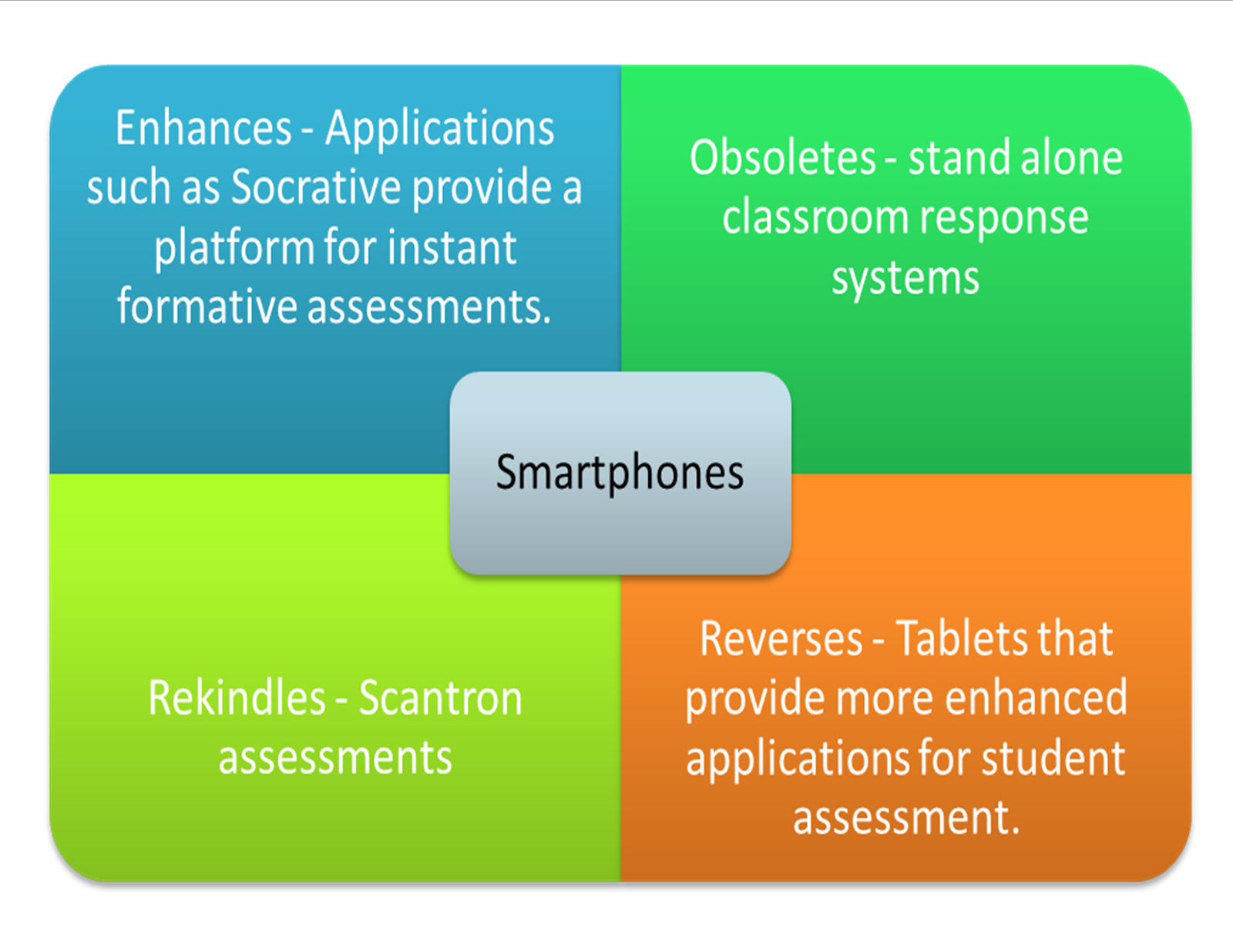
Smartphones in the classroom provide new ways of formative assessments in the classroom. The Bring Your Own Device (BYOD) movement could make traditional classroom response systems obsolete. Meanwhile, these different assessment applications available on most Smartphones rekindle the ease of Scantron tests by quickly scoring assessments and providing classroom data to discover trends. In the future, as tablets become more and more available, these types of assessments will continue to grow to provide more information to educators.
Technology is continuously changing and transitioning the landscapes of our classrooms (Thornburg, 2009). Computer tablets are beginning to show up in schools across the world. The IDC predicts a total of 229.3 million global shipments of tablets in 2013. This is up 57.7% from 2012. When used correctly, this technology has the potential to provide meaningful, authentic learning experiences for students of all ages. Unfortunately, like many educational technologies, teachers don’t understand how to use them for new learning experiences. Instead, they are being used to basic word processing and/or viewing digital videos.
Tablets have the potential to put global learning in the hands of our students. Downloadable applications, that are often free, can be used in creative and innovative ways to maximize student growth that goes beyond basic knowledge acquisition. These skills are what will make our students competitive in the future job market. Tablets provide an equal learning platform that allows students of all abilities and backgrounds positive learning experiences. Meeting individual learning needs for students can be accomplished much easier through tablet computing.
The greatest downside to computer tablets is their incapability with each other. Apple devices such as the iPad run an iOS platform while other tablets may run on Windows or Android. Currently, there isn’t a way to sync information from one platform to another. With the strong competition between these different companies, I don’t foresee this problem being solved any time in the near future. Apple’s lack of compatibility with other devices has been a struggle for Mac users for decades. This issue is only enhanced in the tablet realm. However, despite the pitfalls of tablets in education, the benefits have yet to be fully identified.
For tips on how to use tablets in the classroom, visit TeachThought here.
Allen,
E., & Seaman, J. (2013). Changing course: Ten years of tracking online
education in the United States. Babson Survey Research Group and Quahog
Research Group, LLC.
Presents the research findings on
the state of online learning in the United States. This was the tenth year this research has
been conducted. Surveyed items include
the growth in online education, perceptions and acceptance of online learning
by faculty, as well as the effectiveness of online education in comparison to traditional
educational settings. Statistical graphs
portray the changes occurred during the varying time frames.
Raj,
S., & Al-Alawheh, M. (2010). A Perspective on Online Degrees Vs.
Face-to-Face in the Academic Field Proceedings of the Fifth Conference of
Learning International Networks Consortium. Cambridge, MA; LINC.
Described the perspectives of
employers in regards to the acceptability of online distant education programs
of online doctoral degrees. Delivers
insight into the minds of hiring officials from multiple fields depicting the uncertainties
surrounding online graduate degree programs.
Suggests new approaches to instructional design for online courses could
improve these perceptions.
Richardson,
J. (2010). Online Credentials: A State of Wariness. School Administrator, 67(8),
18-22.
Discusses the skepticisms found in
personnel directors towards individuals with a graduate degree that was
primarily obtained online. School
districts are noted as being reluctant to hire administrators without a
traditional education. Research suggests
that individuals with a degree obtained online are viewed as under qualified to
potential employers.
Shelton,
K. (2011). A Review of Paradigms for Evaluating the Quality of Online Education
Programs. Online Journal of Distance Learning Administration, Volume IV,
Spring 2011(Number I).
Sinow,
R. &.-B. (2012). The Value and Acceptability of an Online Degree in Hiring
Gatekeepers’ choice for Employment in the Multimedia Production Industry. Proceedings
of World Conference on E-Learning in Corporate, Government, Healthcare, and
Higher Education (pp. 1918-1927). Chesapeake: AACE.
Describes the acceptability of
online degrees in the multimedia production industry. Studies show that individuals with experience
in online learning are more likely to accept online degrees. Hiring personnel from technology-based fields
find online degrees more credible than that of management fields. Limitations to peer interaction is viewed as
a weakness of online education. General acceptance
of online degree programs rises.
Udegbe,
I. (2012, March). Attitudes of Prospective Human Resource Personnel towards
Distance Learning Degrees. Online Journal of Distance Learning
Administration, XV(1).
Discusses the attitudes of human
resource personnel towards obtaining online degrees. The majority of those surveyed believed
traditional campus-based universities provided a more rigorous experience. Nearly 43% of respondents stated that they
would not hire someone with an online degree.
Overall, only a third of employers surveys had favorable attitudes
towards online learning.
Vukelic,
B. &. (2011). Employers' evaluation of online education. Annals Of DAAAM
& Proceedings, 1471-1472.
Research studies conducted in
Austria discovered employers held negative opinion towards applicants with
online degrees. 90% stated that online
degrees did not provide adequate skills and/or knowledge for successful
potential employees. It was noted that
often it is difficult to differentiate between degrees obtained online and
degrees earned from a traditional academic setting.
Zain-Ul-Abdin,
K. &. (2010). The acceptability of online degrees in teacher training and
hiring. Proceedings of Society for Information Technology & Teacher
Education International Conference 2010 (pp. 995-1000). Chesapeake, VA:
AACE.
Provides research findings on high
school principals’ acceptance of potential teachers with licensure degrees
obtained online. Findings showed that
95% of those surveyed would not hire a teacher with an online degree. Meanwhile, 99% stated they would choose an
applicant with a traditional education over one with an online degree. The participants’ reasoning was that online
programs could not provide adequate socialization required of effective
teachers.
I believe I fall somewhere between static and dynamic on this continuum. According to Moller (2008), "The middle-of-the-road approaches allow learners to interact with the content." However, in thinking of distance education, I believe that higher levels of learning occur when using more dynamic tools. In order for me to move towards dynamic technologies, I must first gain a deep understanding of how to use the technologies. While I have experience in Google Apps, wikis, and Dropbox, I don't feel like my level of knowledge is enough to be able to successfully integrate them into a distance education setting. Research shows that a teacher's experience with the technologies is more important than teaching experience (Fahy, 2008). Therefore, as I increase my abilities with the different dynamic tools, I will become more effective as a distance education educator.
Fahy, P. (2008). Characteristics of Interactive Online Learning Media. The Theory and practice of online learning (2nd ed., pp. 305-340). Edmonton: AU Press Moller, L. (2008). Static and dynamic technological tools. [Unpublished Paper].
Learners today are using a variety of technological tools
that can be brought into educational settings to enhance learning. Blogs, Skype, email, and streaming video are
tools that many individuals use frequently for personal use. These same tools can be used in online
learning. Blogging is a phenomenon that is widely
used throughout society. From DIY
projects to instructional activities, society utilizes blogs to enhance their personal
knowledge on topics of their choice.
Blogs can be an effective tool in an online setting. Students can explore blogs of experts in the
field to increase knowledge. Ibraheem
Almuhanna states in his blog that blogs offer a place “where authors can
express themselves and reflect on their knowledge while getting feedback and
comments from readers”. Blogs can also
be an assessment medium. Students can
create their own blogs and write on assigned topics to portray knowledge. This gives students the opportunity to gather
feedback from individuals around the globe instead of just the course
instructor.
Wikis are widely used throughout multiple fields. Collaboration is getting a lot of press, and
schools and educators are being urged to incorporate collaboration within their
instruction. Implementing wikis in an
online setting provides students with tools to collaborate with peers from
across the world. Students can work
together to complete a final product.
In addition, since wikis track changes and page edits, it is easy for
instructors to identify individual contributions for assessment purposes. The benefits of this free tool should not be
overlooked.
Isolation is a major concern for many entering an online
setting. However, video conferences
tools such as Skype can help alleviate this problem. Skype has the capabilities of recreating the
face-to-face aspect that many feel is lost through online education. Synchronous discussions can occur in online
learning. Research has shown that using
a variety of tools that are appropriate for specific instructional tasks can
make distance, or online, learning just as effective as traditional learning
(Durrington, Berryhill, & Swafford, 2006).
Almuhanna, Ibraheem (2012).
Online learning tools and communication guidelines. Retrieved from: http://onlinelearningstrategies.blogspot.com/2012/11/the-world-wide-web-offers-many.html
Durrington, V. A., Berryhill, A., & Swafford, J. (2006).
Strategies for enhancing student interactivity in an online environment. College
Teaching,54(1), 190−193.
In distance education, designing
instruction that incorporates a collaborative learning community can be a
difficult task.However, assessing
individual student contribution on the given task can be a greater challenge.While it is acceptable to alter instructional
methods to meet the demands of our ever changing society, we hold tight to the
traditional methods of assessment.However, as we’ve grown to learn that traditional lecture-based
instruction is not always (or mostly) the best method to maximize student
achievement and performance, educators have vastly remained stagnant in
assessing.This unbalance may be why
assessing collaboration or “group work” so difficult for educators in kindergarten
through grad school.
In order to prepare our students
to meet the demands of our ever-changing society, our philosophical shifts must
occur within instruction AND assessment.Building learning communities that foster collaboration requires student
participation (Palloff & Pratt, 2007).The amount of information recall as student obtains is no longer our
main concern. However, the ways in which
students use their knowledge to improve the overall success of the group is
key.Collaboration is often product
focused, but assessing the final product does not give a fair or clear picture
of individual student performance.George Siemens offers multiple suggestions on how to change our
assessment models to match our instructional goals (Laureate Education Inc.,
2008).Peer and self-assessment provide
instructors with insight on how individual contributions lead to final
product.Educators need to assess
collaboration work based on the contributions made by individual students and
how those students fostered interaction throughout the group (Laureate
Education Inc., 2008).Wikis and
learning management systems can track individual contributions throughout the
entirety of a project and assist in accurately assessing participation in
collaboration efforts.This can help
ensure that the product was completed collaboratively by all members of the
learning community.
Not everyone openly embraces
collaboration in a learning community.Often, individual accomplishments were acclaimed in the past and due to
the definition of collaboration, some can have a “loss of self” mentality
(Laureate Education Inc., 2008).This
can lead to failure for not only the individual but the group.Jeffery Hammond reminds us in his blog of the
significance of communicating the individual importance of each group
member.Without individual
participation, the group will be unsuccessful.Instructors and learning communities can take measures to prevent this
from occurring.In the very beginning,
instructors need to ensure that every student feels welcomed and clear and direct
expectations are provided, and learning communities should create a team
charter that explicitly defines individual roles and expectations from within
the group (Palloff & Pratt, 2007).If
this fails, the instructor should step in to mediate without dominating the
group or relinquishing control from the active members (Palloff & Pratt,
2007).Regardless of preventative
measures, there will be times when a student refuses to participate or
participates in a negative manner.This
is why clear and concise expectations given at the start is so important.The groundwork is laid and assessments should
be given based on the initial expectations and charter.Active participants should not be negatively
assessed based on these behaviors.The
instructor may need to reconstruct groups in order for the active participants
to be successful.
Collaboration is an effective and
meaningful instructional strategy that will provide students with the skills
needed to collaborate in the corporate world.Designing appropriate assessments for collaboration is essential for
successful and productive collaboration learning communities.
References
Laureate Education, Inc.
(2008). Principles of Distance Education. Baltimore, MD: Author. Palloff, R. M., & Pratt, K.
(2007). Building online learning communities: Effective strategies for the
virtual classroom. San Francisco, CA: Jossey-Bass.
George Siemens believes that there is a growing acceptance of distance
education throughout the corporate and educational worlds.I agree that distance education is going to
continue to grow at an insurmountable pace due to the benefits provided by
distance education.Increase in global
diversity, communication, and collaborative interaction are the main reasons
Siemens’s believes distance education is going to continue to evolve and become
more and more acceptable (Laureate Education Inc., 2008).
The element of global diversity will be my main focus throughout this
post.Whether you’re an entrepreneur trying
to break through into the global market or on Wall Street trying to make
investments in the global economy, global diversity is a skill that will be
needed throughout all fields in the workforce.Global diversity will no longer be an optional addition to highlight your
resume.It will be a required prerequisite.Alphonse Badoma discusses in his blog
how distance education gives the education field a medium to overcome issues in
regards to diversity.In addition, Teri
Page (2012) states in her blog that “online programs are preparing students
for the corporate world by giving students experiences in working with other
student across the world.”
Distance education
allows students to work with peers and colleagues from around the globe.Prior to enrolling in an online degree
program, the only global interaction I in education was through a foreign
exchange student a friend hosted while in high school.While working on my master’s degree, I took
several courses online with students from different countries.Interacting with them enhanced my personal
learning as well as gave me insight to how education is expanding throughout
the world.Had I attended a traditional
university to further my education, my peers would have been limited to others
who were geographically and culturally equivalent to me.
Technological
advances have provided us with a multitude of tools to interact with peers
globally.Discussion boards, blogs, and chat
rooms have been around for a while and allow for basic interactions.However, technologies such as Skype and wikis
allow more personal interactions as well as collaboration from across oceans. With
the constant evolution of technology, it is impossible to imagine the
capabilities of distance education of the future.
Laureate Education, Inc.
(2008). Principles of Distance Education. Baltimore: Author
________________________________________________________________________________________ Replies to:
In my limited experience, I have found that society often looks down at online learning.I have heard individuals make comments about how it is better to attend a traditional classroom setting as opposed to an online setting despite better accreditation.The evolution of distance education will have to negate these beliefs in order for society to completely adopt this innovation.Often, these comments are uttered from the same mouths that say, “If it was good enough 20 years ago, it’s good enough now.”
Moller, Foshay, Huett, and Coleman (2008) believe that the evolution of distance education needs to occur within instructional design.I strongly agree with this belief.Teacher preparation programs prepare educators to enter a traditional classroom.While technology has become a big emphasis in this, online learning has not.Many teachers are not prepared to enter such an environment as online learning.Many of the tactics used within a classroom setting are nonexistent in an online setting.Therefore, just as traditional systems have instructional specialists constantly staying abreast best practices in the classroom, distance education needs its own experts in instructional design.
In addition to discriminating between the instructional approaches of traditional vs. online classrooms, the individual students need to be considered as well.Moller, Foshay, and Coleman (2008) state that “the personal and psychological characteristics of successful online learners include autonomy, metacognition, self-regulatory skills, positive self-efficacy, motivation, and internal locus of control.”A world where every student encompasses these skills exists in fairytales.We accept the differences among students in a traditional classroom, so why should we assume these differences disappear when entering a learning environment with even larger boundaries?
Simonson (2000) argues that the Equivalency Theory should be used in regards to online learning.I believe this is accurate as well.While the learning outcomes should remain the same for both environments, the roads to meet those are different (Simonson, 2008).Just as students have different learning styles, different learning environments require different means. Like a traditional classroom, distance education settings must evolve the meet the ever-changing state of society.Distance education provides a medium to meet many of the needs that are missing in a face-to-face setting.However, the needs to maximize learning must be met.
Huett, J., Moller, L., Foshay, W. & Coleman, C. (2008, September/October). The evolution of distance education: Implications for instructional design on the potential of the Web (Part 3: K12). TechTrends,52(5),63–67.
Moller, L., Foshay, W., & Huett, J. (2008, May/June). The evolution of distance education: Implications for instructional design on the potential of the Web (Part 1: Training and Development). TechTrends, 52(3), 70–75.
Moller, L., Foshay, W., & Huett, J. (2008, July/August). The evolution of distance education: Implications for instructional design on the potential of the Web (Part 2: Higher Education). TechTrends, 52(4),66–70.
Simonson, M. (2000). Making decisions: The use of electronic technology in online classrooms. New Directions for Teaching and Learning, 84, 29–34.
Simonson, M. (Presenter). (2008). Distance education: the next generation. [Vodcast]. Laureate Education, Inc. Blog replies to:


 Posts
Posts

